
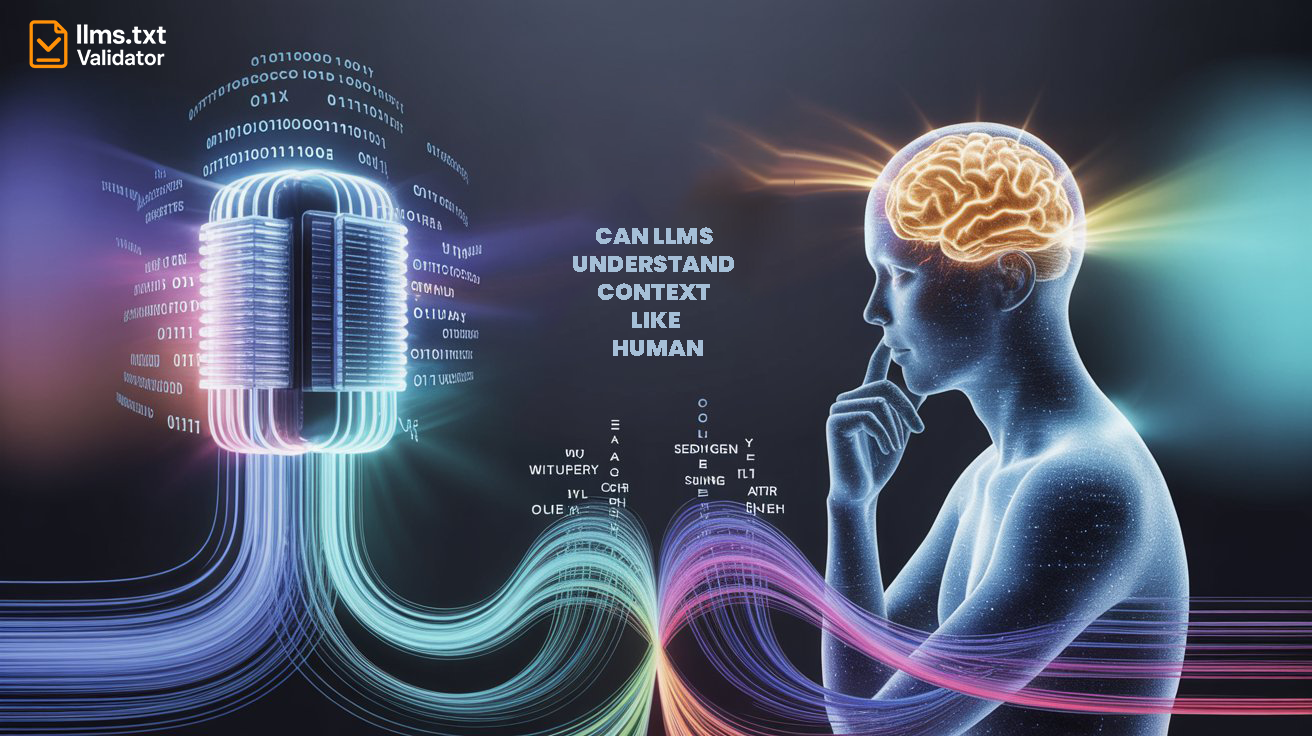
Can Large Language Models Understand Context like Humans?
Interacting with ChatGPT or any advanced AI assistant often feels like the AI understands you. You ask a question, it responds coherently, and it even appears to remember your previous inputs. But does it truly understand context the way humans do? Let’s explore the intricate workings of AI, transformers, and prompt engineering, and understand what this means for the future of context-aware systems. If you are new to LLMS, check out our comprehensive guide on What is LLMS.
In natural language processing (NLP), context involves more than merely recalling previous words. It requires understanding semantic meaning, intent, relationships between concepts, and the flow of ideas. Humans use experience, memory, and reasoning to interpret meaning, whereas large language models (LLMs) rely on statistical learning, token embeddings, and attention mechanisms.
Before diving deeper into how transformer models handle context, let’s define some key terms:
|
Term |
Simple Meaning |
|---|---|
|
Large Language Model (LLM) |
A deep learning model designed to predict and generate human-like text. |
|
Transformer Model |
The neural network architecture powering most LLMs, including ChatGPT, Claude, and Gemini. |
|
Attention Mechanism |
A method that allows the model to focus on the most relevant words or tokens in a sequence. |
|
Context Window |
The maximum amount of text the model can “see” or retain at a given time. |
|
Token Embeddings |
Numerical representations of words or subwords that capture semantic meaning. |
These components collectively enable LLMs to approximate context understanding, though their comprehension has limitations.
How Large Language Models Operate (Beyond the Hype)
To truly grasp how ChatGPT and transformers work, consider this fundamental principle:
A language model predicts the next token based on all preceding tokens.
Every “thought” an LLM generates stems from probabilities rather than conscious reasoning. For instance, if you type “The cat sat on the,” the model predicts that “mat” is the most probable next word. However, as sentences grow longer, maintaining context becomes critical. This is where the attention mechanism in transformers plays a pivotal role.
Understanding the Attention Mechanism
The attention mechanism enables the model to assign importance to different parts of the input text. Consider the sentence:
Alice gave the book to Mary because she loved reading.
The model must determine who “she” refers to. Attention weights guide it to link “she” with “Mary,” not “Alice.” This ability to interpret semantic meaning and context is what makes transformer-based models far more effective than older machine learning methods. Attention mechanisms act like a spotlight, highlighting critical relationships between words. This allows semantic AI models to process complex linguistic structures, metaphors, co-references, and even humor. For a deeper dive into its workings, read our detailed guide on How do Large Language Models Work.
How Transformers Encode Context Across Layers
Deep learning models such as GPT or Claude operate across dozens or even hundreds of layers.
|
Layer Type |
What It Learns |
|---|---|
|
Lower layers |
Grammatical structure, syntax, and token relationships |
|
Middle layers |
Semantic meaning and contextual relationships |
|
Upper layers |
Task-specific reasoning, coherence, and factual recall |
Through this hierarchical encoding, LLMs develop their notion of “understanding.” Unlike humans, who connect ideas via reasoning, LLMs represent meaning mathematically across embeddings. This process, also called meaning representation in AI, allows language models to encode semantic relationships numerically.
The Impact of Prompt Engineering on Context Comprehension
Prompt engineering plays a crucial role in context management. Even the most sophisticated LLMs rely on how you phrase your queries. Prompt engineering involves designing inputs so the model can efficiently retrieve and apply context within its window. For example:
Poor prompt:
“Explain transformers.”
Effective prompt:
“Explain the transformer model in simple terms, detailing how attention mechanisms and token embeddings enable large language models to grasp context and meaning.”
The second prompt provides semantic hints that help the model focus accurately. Prompt engineering aligns human intent with the AI’s statistical framework. By optimizing prompts, you guide the model’s use of attention and context memory, ensuring coherent responses in multi-turn conversations.
Context vs Keywords: A Modern SEO and AI Analogy
Traditional SEO focused heavily on keywords, but modern NLP and AI prioritize context and semantics. Understanding context in AI mirrors how search engines interpret queries today. Instead of simply matching words, they assess intent and meaning. Semantic AI models now focus on conceptual relationships, not just word frequency. For instance:
This approach resembles Google’s semantic search methodology, emphasizing content that satisfies intent rather than keyword stuffing.
How LLMs Interpret Meaning and Their Limitations
LLMs simulate understanding through token embeddings and probabilistic context mapping, but they do not think like humans.
Each token embedding carries latent information about:
After exposure to millions of examples, the model develops statistical representations of meaning. Yet, it struggles when:
These issues, known as context collapse or knowledge decay, persist despite attention mechanisms. Recent research on LLMs and context encoding suggests that while attention improves short-term semantic reasoning, models still struggle with long-range dependencies. Approaches like out-of-context reasoning (OOCR) and retrieval-augmented generation (RAG) use external memory to fill these gaps.
Scientific Insights on Context Understanding
Here are key findings from influential studies:
|
Research Focus |
Finding |
|---|---|
|
Context Understanding Benchmark (4 Tasks, 9 Datasets) |
LLMs perform well on surface tasks but struggle with implicit discourse |
|
Quantization Trade-off (3-bit models) |
Smaller models lose nuanced context |
|
Layer-wise Probing |
Upper layers encode contextual dependencies |
|
Forgetting Phenomenon |
Models overwrite earlier context |
|
Scaling Laws |
Larger models handle longer context better |
These findings explain why transformer models remain powerful yet imperfect—they statistically encode meaning without cognitive understanding.
The Importance of Embeddings in Context Comprehension
Embeddings form the numerical backbone of words in AI. They capture semantic meaning, relationships, and contextual similarities. For example:
|
Word |
Nearest Embedding Neighbors |
|---|---|
|
“Apple” |
fruit, orchard, banana |
|
“Apple (brand)” |
iPhone, Mac, device |
The model uses context to differentiate meanings. Through attention mechanisms and transformer layers, embeddings adapt dynamically, creating contextualized embeddings. Each token evolves based on surrounding words, explaining how AI encodes meaning.
AI Semantics vs Human Understanding
Humans rely on experience and reasoning, while AI relies on pattern recognition. Semantic meaning in LLMs can appear insightful but may miss subtle nuances:
Thus, LLM context understanding remains an evolving challenge.
Practical Significance of Context for AI Systems
Maintaining context is crucial. Without it, AI loses coherence, affecting chatbots, search engines, and content generators.
Real-world consequences include:
For developers, context failure can result in misinformation, bias, and unreliable models. Tools like LLMs Validator help validate metadata such as llms.txt, ensuring AI output adheres to best practices and ethical standards.
Strategies to Enhance Context Understanding
The Future of Context-Aware AI
AI is advancing rapidly, but distinguishing between pattern recognition and true understanding remains challenging. Future models may combine:
This hybrid, reasoning-driven approach may bring us closer to genuine context comprehension in AI.
Final Thoughts: Moving Toward True Context Awareness
The question, “Can large language models understand context like humans?” lacks a simple answer. LLMs approximate understanding statistically rather than consciously. Every advancement in attention mechanisms, prompt engineering, and semantic modeling brings AI closer to human-like comprehension. If you work in AI, NLP, or machine learning, you contribute to this ongoing evolution. Validating how models interpret and utilize context is crucial for trust, compliance, and quality in AI systems.