
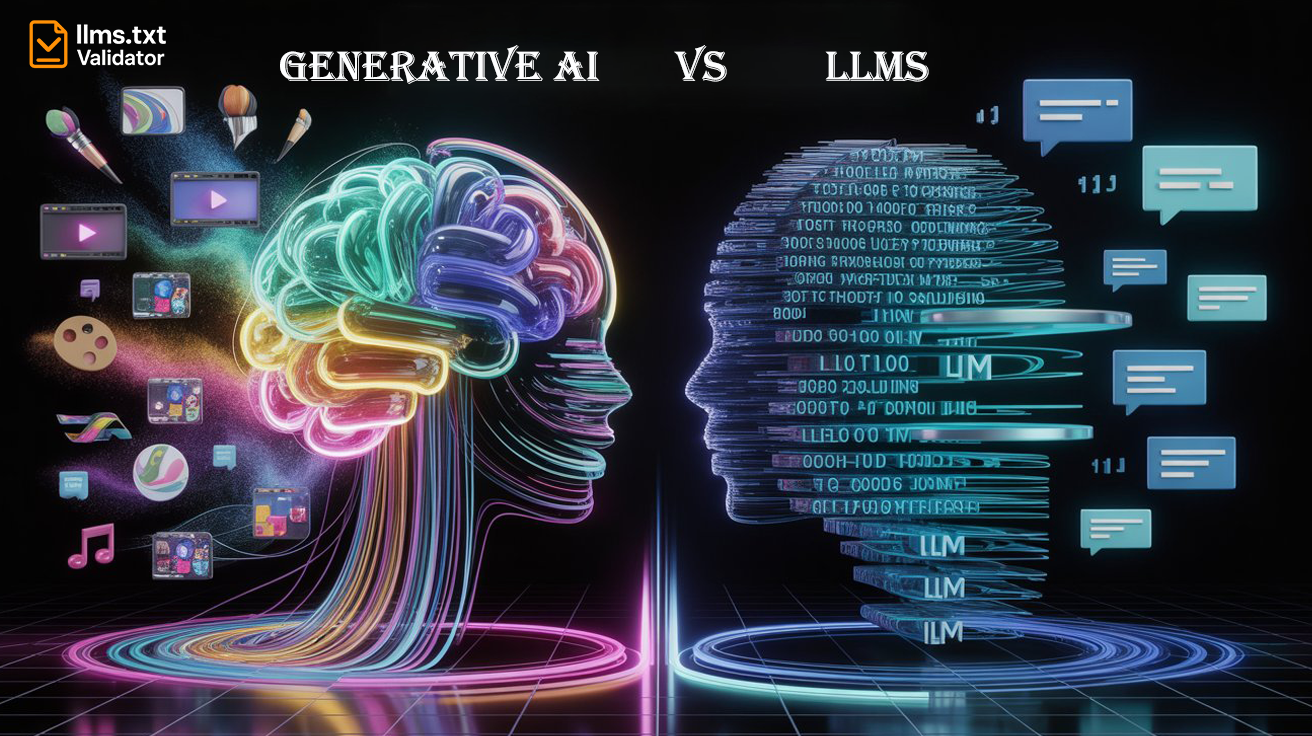
Generative AI vs LLMs: Key Differences Explained (2026 Guide)
Artificial intelligence has become an integral part of daily life. From composing emails with ChatGPT to creating stunning art using DALL·E or Midjourney, AI tools are everywhere. While Generative AI and Large Language Models (LLMs) are often mentioned interchangeably, they serve distinct roles within the AI ecosystem. Generative AI refers to a broad class of AI systems capable of producing diverse content, whereas LLMs focus specifically on language and text. If you are new to these concepts, our What is LLMs article provides a detailed introduction to their design and training.
What Is Generative AI?
Generative AI, or GenAI, encompasses artificial intelligence systems that create original content based on patterns learned from large datasets. This content can include text, images, videos, audio, and even code. Generative AI leverages advanced machine learning algorithms to produce unique outputs that emulate human creativity.
The Creative Side of Artificial Intelligence
Unlike traditional AI models that analyze or classify existing data, Generative AI produces new information. It identifies relationships and patterns within training data to generate outputs that are fresh but stylistically or contextually similar. For instance, a text prompt can prompt DALL·E to generate a realistic image or GPT-4 to produce a completely original article.
Core Foundation Models Behind Generative AI
Generative AI relies on foundational architectures such as Generative Adversarial Networks (GANs), Variational Autoencoders (VAEs), Diffusion Models, and Transformer-based Neural Networks. These models apply deep learning and pattern recognition to understand complex data relationships. Developers fine-tune these foundation models for tasks such as music composition, article writing, or video generation.
Popular Generative AI Tools in 2025
In 2025, Generative AI powers numerous creative applications. Top tools include DALL·E and Midjourney for images, Runway ML and Synthesia for video, Gemini for content analysis, Claude 3.5 Sonnet for writing, and ChatGPT 4o for text generation. These platforms transform marketing, design, and entertainment by automating creativity and boosting productivity.
What Are Large Language Models (LLMs)?
Large Language Models are a specialized subset of Generative AI that understand, process, and generate human-like text. Built on transformer-based deep learning frameworks, LLMs capture context, tone, and meaning. They excel at tasks such as summarizing text, answering questions, translating content, and generating high-quality written material.
How LLMs Work (in Simple Terms)
LLMs train on massive text datasets, including books, websites, and code repositories. Through training, they learn grammar, semantics, and context. Their key mechanisms include tokenization (breaking text into units), attention mechanisms (tracking relationships between words), and reinforcement learning (improving results through feedback). For a more detailed technical explanation, see our post How Do LLMs Work.
Top LLMs Dominating 2025
Leading LLMs include GPT-4o by OpenAI, Claude 3.5 Sonnet by Anthropic, LLaMA 3 by Meta, BERT and RoBERTa by Google, Cohere by AI21 Labs, and Gemini by Google DeepMind. These models contain billions or even trillions of parameters, enabling them to generate highly fluent and coherent text.
Everyday Applications of LLMs
LLMs now serve diverse functions, such as automating customer support, generating marketing copy, assisting developers with coding, translating languages, summarizing documents, and suggesting content for blogs and social media. They have become essential tools for enhancing communication and productivity across sectors.
Generative AI vs LLMs: Key Differences
Both belong to the AI family, but they differ in scope and purpose. Generative AI covers all AI capable of creating new content, while LLMs are a specific form that focuses on text.
Comparison Table
|
Aspect |
Generative AI |
Large Language Models (LLMs) |
|---|---|---|
|
Definition |
AI systems that create new content such as text, images, video, and music. |
A subset of Generative AI focused on generating and understanding text. |
|
Core Models |
GANs, VAEs, Diffusion Models, Transformer Networks |
Transformer-based models like GPT, Claude, LLaMA, and BERT |
|
Output Type |
Text, images, audio, and video. |
Primarily text-based output. |
|
Use Cases |
Image generation, music, product design, multimedia storytelling. |
Writing assistance, chatbots, translation, summarization, code generation. |
|
Limitations |
May produce misleading content or plagiarism risks. |
Can hallucinate, display bias, and face scaling issues. |
An Easy Analogy
Think of Generative AI as a creative studio director overseeing multiple departments, while LLMs are the writers who craft the scripts. The director sets the vision, and the writers translate it into language.
The AI Hierarchy: From General Intelligence to Language Models
AI can be viewed as a layered hierarchy, becoming more specialized as it progresses. It starts with general AI, narrows to Machine Learning (ML), focuses further with Deep Learning (DL), and then reaches Generative AI and LLMs.
For insights on monitoring brand exposure in these AI systems, read our guide How to Audit Brand Visibility on LLMs.
Advantages and Limitations
Both technologies have transformed creativity, productivity, and automation, though they also present challenges.
Major Benefits
Generative AI and LLMs enhance creativity by generating text, visuals, and code quickly. They improve personalization, streamline repetitive tasks, support multilingual communication, and enable individuals with limited technical expertise to produce professional-quality outputs.
Common Limitations
Both are prone to hallucinations, producing incorrect or misleading outputs. They can perpetuate bias present in training data and raise concerns over privacy, copyright, and transparency. Maintaining large models requires significant computational resources. Developers address these issues through bias mitigation, evaluation, and responsible AI frameworks.
Real-World Applications
Generative AI and LLMs often complement each other in business workflows, enabling high-quality content creation, automation, and data-driven decision-making.
Content Creation and Marketing
Generative AI creates blog posts, social media captions, and visual branding, while LLMs generate articles, summaries, and ad copy. Together, they accelerate marketing campaigns and automate creative workflows.
Coding and Software Development
LLMs such as GPT-4 and LLaMA 3 assist developers with code generation, documentation, and debugging. Generative AI supports UI creation and repetitive coding tasks. Tools like GitHub Copilot integrate these models to enhance productivity and accuracy.
Customer Support and Chatbots
Generative AI powers human-like chatbots and virtual assistants, while LLMs interpret queries and generate precise responses. Generative AI can create follow-up emails, voice responses, or tutorials, improving customer service efficiency.
Data Analysis and Visualization
LLMs analyze text, summarize reports, and detect trends, while Generative AI generates dashboards, charts, and visual presentations. Together, they support faster and better business decisions.
Education and Training
LLMs assist with writing, question answering, and summarization. Generative AI enhances learning through interactive videos, quizzes, and simulations, promoting personalized education. We also trained AI using the llms.txt file on our website.
Try the LLMS Validator Tool to validate your LLMs file and explore how your data interacts with different models.
Myths and Misconceptions
Ethical AI, Data Quality, and Bias Mitigation
AI outputs depend on the quality of training data. Biased or low-quality data can lead to misleading results. Ethical AI focuses on fairness, accountability, and transparency. Techniques like data filtering, reinforcement learning from human feedback, and bias detection help reduce risks, ensuring AI benefits society while respecting privacy and diversity.
Future Trends
The future of AI emphasizes autonomy and multimodality. Autonomous AI agents can perform complex tasks combining reasoning and creativity. Self-learning models improve through continuous feedback, while multimodal AI merges text, image, and audio into unified experiences. Local AI models like LLaMA 3 enable offline execution. Human-AI collaboration will continue to grow, augmenting human expertise rather than replacing it.
Conclusion
Generative AI and LLMs represent two complementary aspects of AI innovation. Generative AI provides the foundation for diverse content creation, while LLMs bring language intelligence. Together, they transform how humans create, communicate, and innovate, shaping industries and empowering individuals for a more intelligent and creative future.