
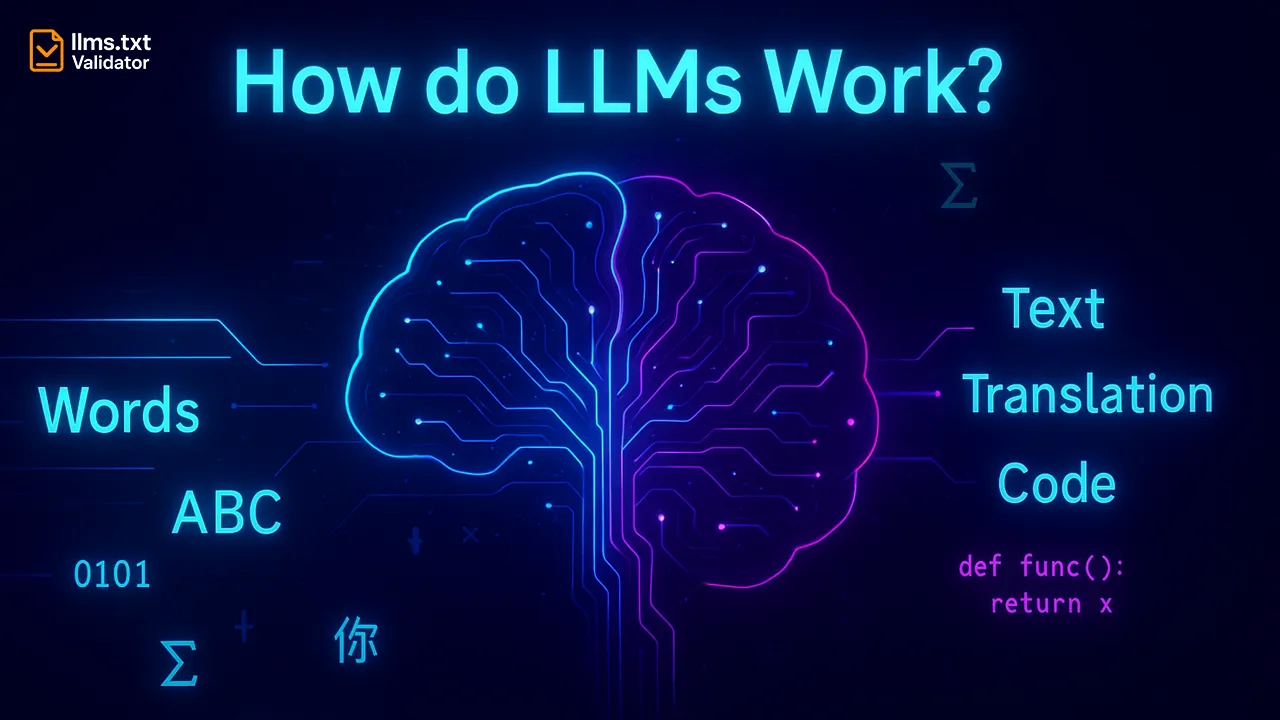
How LLMS Work: A Practical 2026 Guide
Large Language Models (LLMs) have moved from research labs to everyday tools. Whether you interact with ChatGPT, AI assistants, or AI-generated summaries, you’ve already seen their impact. But what happens behind the scenes? More importantly, how can you, as a business owner, developer, or curious reader, leverage LLMs effectively? This guide explains How LLMs Works. The mechanics in simple terms, covering applications, challenges, and future trends.
What Are Large Language Models (LLMs)?
LLMs are AI systems trained on vast text datasets. Their primary goal is to predict the next word in a sequence, but they do so at a scale that mimics reasoning. Think of them as highly advanced autocomplete engines capable of writing essays, solving problems, answering questions, and generating code. Unlike rule-based systems, LLMs use deep learning and neural networks to learn language patterns, structures, and nuances, making them adaptable across industries and use cases. Beginners should refer to What is LLMs? for basics.
Core Mechanics Behind How LLMs Work
How do LLMs generate human-like text? Let’s break it down.
Neural Networks and Deep Learning
LLMs rely on neural networks, computational systems loosely inspired by the human brain. Layers of “neurons” pass signals forward, adjusting parameters during training to make accurate predictions. Deep learning means these networks have multiple layers, allowing them to detect subtle language patterns. More layers equal more complexity, which is crucial for processing unstructured data like text and images.
Transformers and Self-Attention
Transformers, introduced in 2017, revolutionized AI. Unlike older models, transformers analyze entire sentences or paragraphs to determine which words are most important. Self-attention enables each word to evaluate the significance of others. For instance, in “The animal didn’t cross the street because it was too tired,” self-attention helps the model link “it” to “animal,” not “street.”
Autoregressive Text Generation
Autoregression allows transformers to predict one word at a time, then use that prediction for the next word. For example, asking “What color is grass?” will likely yield “green.” This rapid, word-by-word generation produces fluent sentences, paragraphs, and articles that feel natural.
Training Phases: Pre-Training, Fine-Tuning, RLHF
LLMs train in three stages:
This layered training gives modern LLMs, like GPT-4, a conversational and context-aware quality.
Why LLMs Are Powerful
LLMs excel because of their scale and emergent abilities, skills they discover through training rather than explicit instruction.
Emergent Abilities: Reasoning, Zero-Shot, and Chain-of-Thought
LLMs can solve puzzles or problems they’ve never seen, demonstrating zero-shot learning. Chain-of-thought prompting allows step-by-step reasoning, similar to human problem-solving.
Scaling Parameters and Data
Larger models can capture more patterns. While BERT had 110M parameters, GPT-4 exceeds a trillion. More parameters and data lead to smarter, nuanced outputs.
Real-World Applications
Chatbots and Virtual Assistants
LLMs power chatbots and virtual assistants, reducing wait times and handling repetitive queries while freeing human agents for complex tasks.
Content Creation and Summarization
Marketers draft blogs, emails, and social posts; researchers summarize papers; students condense notes efficiently using LLMs.
Data Analysis and Coding
LLMs parse data, analyze text, and generate code snippets or SQL queries, accelerating workflows.
Industry Use Cases
Using llms.txt for AI Indexing
Similar to robots.txt, llms.txt guides how AI systems crawl and learn your website content. Businesses can include, exclude, or prioritize pages for AI indexing. Validate your llms.txt file with our LLMS txt Validator tool.
Challenges and Limitations
Hallucinations
LLMs may generate confident but incorrect outputs, so verify critical information.
Bias and Ethics
LLMs inherit human biases from training data. Responsible AI practices are essential to ensure fairness.
Cost and Environmental Impact
Training large models consumes massive resources. Green AI seeks efficiency without sacrificing performance.
Scalability and Alignment
As models grow, aligning outputs with human values becomes challenging, requiring careful fine-tuning and RLHF.
Practical Use of LLMs
Prompt Engineering
Choosing Tools and Platforms
Select LLMs like OpenAI GPT, LLaMA, or other models based on cost, scalability, privacy, and customization needs.
Tips for Businesses and Developers
The Future of LLMs
Open Source vs Proprietary Models
Open-source models enable greater control and innovation, especially for niche industries.
Small Language Models (SLMs)
SLMs run locally for lightweight tasks, complementing LLMs for complex reasoning in hybrid systems.
Responsible and Green AI
Regulations will focus on transparency, energy efficiency, and ethical AI. Early adopters gain trust and a competitive edge.
Final Thoughts
LLMs are transforming work, learning, and communication. They provide efficiency while raising ethical and trust considerations. Combining human creativity with LLM capabilities ensures competitive advantage in 2025 and beyond.